

Net Zero: Bin It Or Back It?
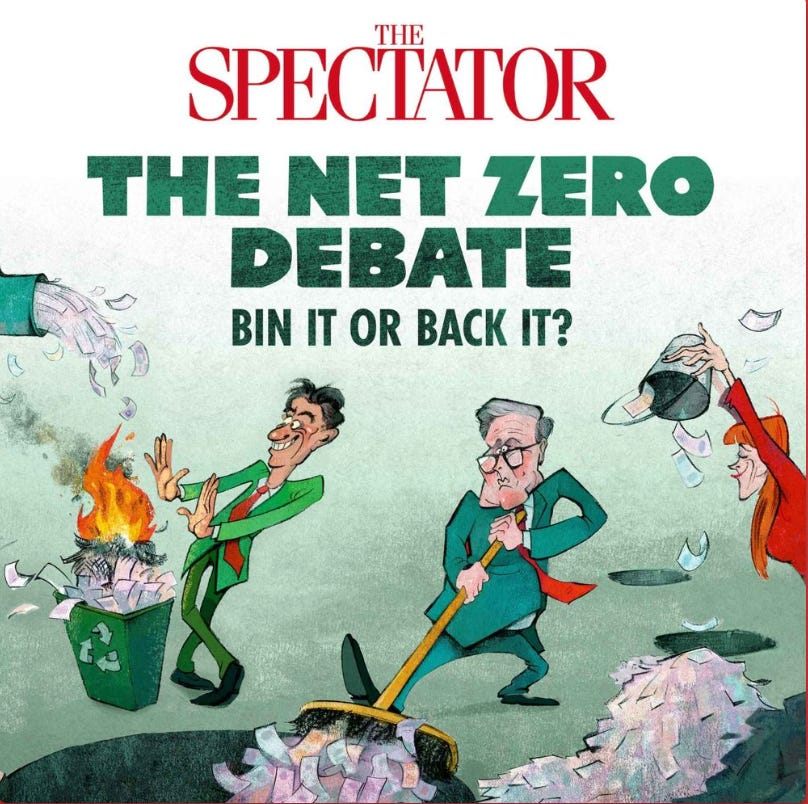
I took part in a debate hosted by The Spectator on the future of the UK's climate and energy policy. Here's the full transcript of the speech I gave ..

For nearly two decades, net zero has sat at the heart of Britain’s policy agenda. Once framed as a clear moral imperative, political parties promised to slash carbon emissions as ministers raced to position the UK as a leader on the world stage.
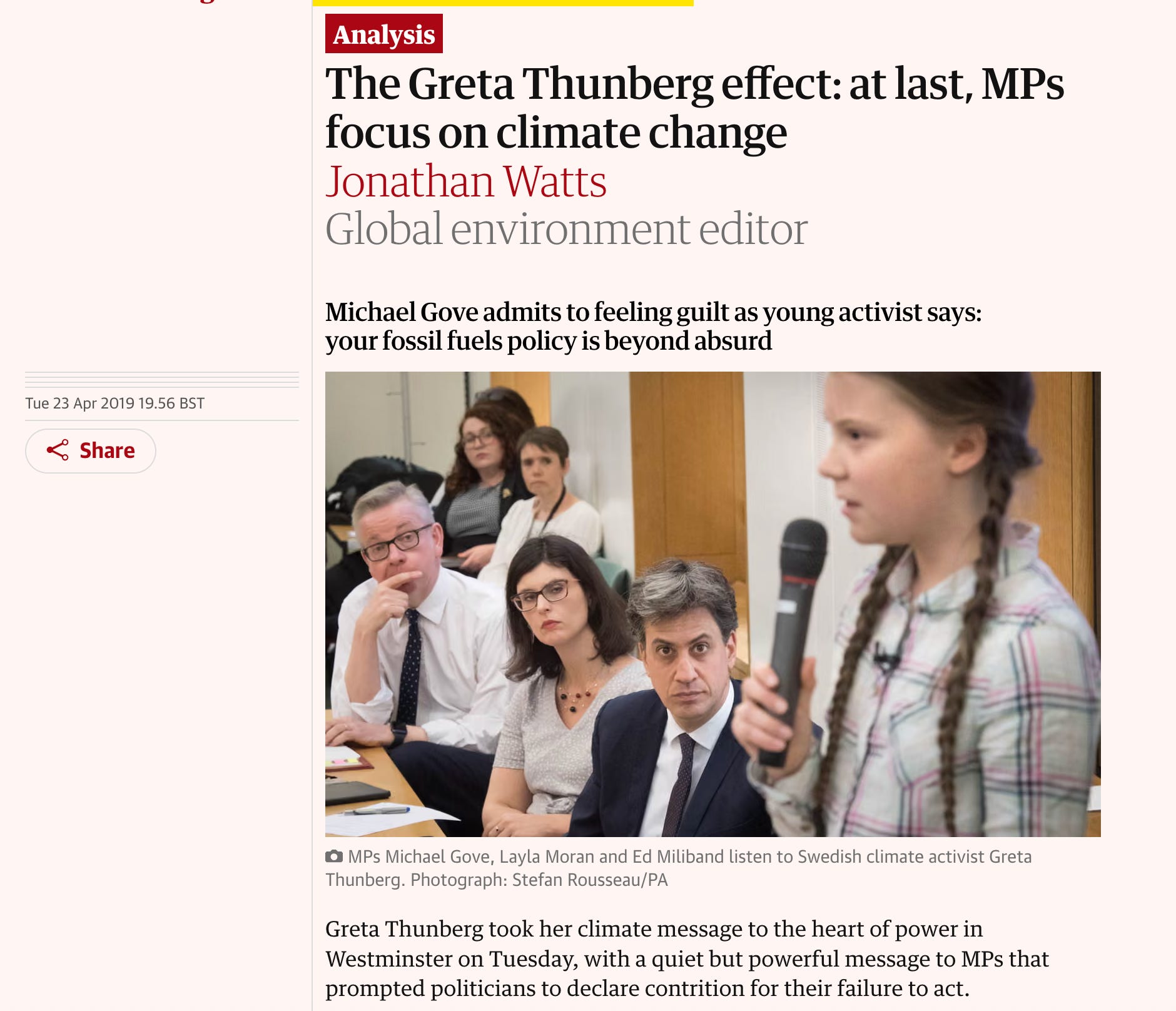
Leading politicians, filled with a moral fervour to “do the right thing”, clamoured to be seen convening with climate campaigners, not least the youthful Swedish activist Greta Thunberg – who, for a while, was the toast of endless exclusive dinner parties and countless international conferences.
But as economic pressures and global instability has mounted over recent years, logistic and commercial realities have loomed large and that “net zero” consensus has begun to fray. Thunberg’s public standing has become significantly more polarized – while she retains upport from environmentalists and youth activists, she has lost much of her mainstream, cross-political appeal and is viewed by critics as dangerously radical and divisive.
Thunberg is now often referred to by critics, cruelly but memorably, as “the doom goblin” – a phrase first used by Talk Radio host Kevin O’Sullivan.
Recent shocks – from the pandemic to war-driven energy crises – have exposed the fragility of supply chains and the risks of over-reliance on external energy sources. While renewables like wind and solar can supplement carbon fuels, they also raise fundamental questions around cost, subsidy and reliability. At the same time, drilling for oil in the North Sea has long been penalised by successive governments, but particularly since Labour took office in 2024.
So where does this leave Britain? As a relatively small contributor to global emissions, is the UK leading the way in adopting net zero – or putting its own economic resilience at risk?
Last week – on Wednesday 20th May – I took part in a debate hosted by The Spectator at the Emmanuel Centre Westminster: “Net Zero - bin it or back it?”.
I was speaking in favour of the “bin” side of the motion, along with former Tory cabinet minister Lord Peter Lilley. We were up against Bob Ward, of the influential Grantham Research Institute on Climate Change and the Environment, and Shahrar Ali, former deputy leader of the Green party. The debate was expertly chaired by The Spectator’s assistant editor, Isabel Hardman.
Below is the transcript of the speech I gave – each speaker has a 7-minute time slot – and if you click on the image below, you can hear an excerpt from the debate

Liam Halligan, Net Zero speech
Spectator Debate, 20/05/26
Thank you Isabel. And thank you to the Spectator for the invitation to propose the motion – “Net Zero: Bin it or Back it” – in this evening’s debate.
Back in early 2025, Rachel Reeves was insisting there was “no trade-off between economic growth and net zero”. A rapid transition towards green energy and away from fossil fuels was, the Chancellor argued, the “industrial opportunity of the 21st century”.
Assaulted by economic and fiscal reality, Reeves quickly changed her tune.
“Well-meaning” green regulations have gone “too far in one direction”, she told a Washington audience a few months later. The Chancellor cited overly-zealous environmental measures as a major barrier to investing in essential UK infrastructure, labelling some of them “absolutely insane”.
But Reeves has lost the argument, ceratinly with her party. The Chancellor’s rhetorical volte face has done little or nothing to impact policy, as the government has since continued robotically to load up companies with net zero-related costs.
Major industrial sites have continue to close or impose job cuts, with companies, trade unions and industry analysts directly citing net-zero policies as a key factor.
Last year, the historic Vauxhall/Stellantis van plant in Luton closed, ending 120 years of manufacturing, followed by Scotland’s sole oil refinery at Grangemouth and Lincolnshire’s Lindsey refinery. In each case, the decision was demonstrably driven by environmental regulation and sky-high UK energy costs, inflated as a direct result of net-zero policies.
Only in March, production ended at Mossmorran in Fife, a core ethylene plant which employs 400 workers, after more than 40 years of operation.
The future of the UK’s only remaining blast furnace remains in the balance, after British Steel’s Chinese owners walked away from the Scunthorpe plant – again in part due to net zero policies. We’ve already seen, of course, the end of 100 years of primary steel-making at Port Talbot, resulting in thousands of redundancies across the site and its supply chain.
At a time when the world is becoming increasingly unstable, and global supply chains are under serious threat, why are we becoming ever more reliant on imported steel?
Electric Glass Fiber UK recently closed it Wigan plant, with INEOS Acetyls also making deep job cuts at its Hull chemical facility, both pointing to net-zero policies and an inability to compete against high-carbon imports.
And at Billingham on Teesside and Ince in Cheshire, ammonia and fertiliser plants have respectively closed – again, producing economically vital outputs and, again, due to net-zero-related carbon taxes and other extremely costly regulations.
These are just some examples of the industrial casualties in the UK, and only in the last couple of years.
On top of all those job losses and foregone tax revenues, oil and gas extracion in the North Sea has also plunged over the past decade, previously supporting more than 400,000 well-paid jobs but now less than 100,000, after thousands more went in 2025.
These North Sea losses have been driven not so much by falling reserves – there remains literally billions of barrels of proven and probable oil equivalent in the UK’s part of the North Sea, and far more in prospective reserves – but by net zero policies – not least the highly punitive Energy Profits Levy, which has hiked the headline rate on corporate earnings to a ludicrous and growth- and investment-sapping 78pc.
Then there’s the zero-emission vehicle (ZEV) mandate, banning the sale of new petrol and diesel cars by 2030.
The European Commission’s ZEV-mandate, by contrast, has long been set at 2035. And in recent months, common sense has prevailed on the continent and even that later ban than ours has been significantly watered down, and effectively removed completely.
Yet the UK government has carried on with its green virtue-signalling regardless. Who cares if UK car production fell no less than 16pc last year to its lowest level since the early 1950s, with countless industry sources talking of “the toughest year in a generation”?
Who cares if Britain’s brain-dead determination to continue alone with this 2030 ban hands a huge slice of our car market to heavily subsidised Chinese-made electric vehicles, manufactured using energy from one of the country’s 3,000-plus coal-fired power plants?
This take-over is already happening. In 2024, imports from China accounts for just under 5pc of all cars sold in the UK. Last year it was around 10pc and during the first four months of 2026, that figure has shot up to 15pc – with the import surge dominated by Chinese-made EVs.
The UK’s automotive industry still employs upward of 800,000 – many holding decent, well-paid jobs in parts of the country where such jobs are scarce. Surely, this matters.
This government’s bull-headed refusal to revisit the ZEV-mandate is ripping the heart out of a once world-beating industry, with massive implications for jobs, growth and the UK’s social fabric.
The UK’s extreme net zero policies were introduced under the Conservatives, of course. It was David Cameron’s government that cemented the UK’s commitment to who-cares-about-the-cost environmentalism, determined as he was to counter the Tories’ “nasty party” image.
And it was Theresa May – the original source of that loaded soubriquet – who in 2019 committed Britain to reaching net zero emissions by 2050, making it the first major economy to set that target in law.
Tory leader Kemi Badenoch last year shifted her party’s policy, declaring the UK’s “net zero 2050” targets “impossible” – for which she deserves credit. As a new MP and trained engineer, she was one of very few voices in Parliament who raised doubts about May’s 2019 legislation – again, kudos to her.
Since then, the Tories’ pronouncements on energy and environmental policy more generally have been more sensible. But the reality is that the net zero obsessions of Westminster time-servers, well-heeled activists, the subsidy-grabbing green industrial complex and “polite society” more generally are still doing serious economic damage.
The UK has a relatively high share of what Energy Secretary Ed Miliband insists on calling “cheap renewables” – which produce around two-fifths of our electricity. But the subsidies involved, added to bills, mean despite the growing use of renewables, or actually because of it, UK firms and households are paying the highest electricity prices of any major economy in the world.
This is a major reason why UK inflation and our economy is failing to grow. And these two trends are, in turn, in the face of ongoing high public spending, destroying our public finances to the extent that Britain is now on the cusp of a major bond-market meltdown.
Why should we bin net-zero? Because it simply isn’t delivering for ordinary people, but is instead adding to their financial burden and, in many cases, undermining any vestige of job security. That’s why, since 2021, the share of the UK public wanting the UK to “hit net zero before 2050” has almost halved, from 54pc to 29pc, according to a study by King’s College London.
The consensus backing net zero has, as even Keir Starmer has admitted, “broken down”. And not a moment too soon.
And now, of course, geopolitical realities are making a nonsense of our net zero obsession. Brent crude is currently $108 per barrel – up from $66 at the end of February, when this US/Iran war began in earnest.
The share of the UK public wanting the UK to “hit net zero before 2050” has almost halved
Given the damage done to the Middle East’s oil infrastructure – and with strategic petroleum reserves fast depleting, crude is set to go significantly higher in the months to come.
Back in 1973, when the Israel-Egypt Yom Kippur war sparked the Arab oil embargo, causing major problems for big western energy importers, the world economy used 55 million barrels of oil per day. Last year, that figure was 105 million, almost double. Oil is still vital across a range of sectors – not just for energy and transport but petrochemicals, lubricants and the manufacture of all kinds of polymers and plastics.
Fossil fuels - oil and gas – still account for some 70pc of the UK’s primary energy production. Yes, renewables are 40pc of our electricity generation, but electricity is merely a fifth of our primary energy use. Again, hydrocarbons are 70pc of our primary energy.
Don’t worry – it’s a mistake journalists, MPs and often even ministers makes all the time, to confuse the difference between share of renewables in electricity and our broader primary energy use.
Even if ultra-optimistic official “net zero” targets for renewable energy are met, oil and gas will continue to be vital for decades to come. You wouldn’t think it, given how successive governments have regulated and taxed North Sea production almost into oblivion.
And as pulverising tax rates introduced under the Tories – and Labour’s further rises and subsequent drilling ban – have hammered North Sea production and investment, related tax revenues have also plunged – from £9.9bn in 2022, when the energy-profits levy was introduced, to £5.4bn the following year and £4.5bn in 2024-25.
During this financial year, 2025-26, the Office for Budget Responsibility estimates just £2.7bn of North Sea revenues, barely a quarter of the revenues raised before the energy profits levy was introduced. And yet minsters continue with their absurd, economically-illiterate propaganda about “stopping the oil and gas companies from exploiting us so we can support hard-working families.
And just as billions of pounds in much-needed government revenue has been sacrificed on the “net zero” altar, so have jobs. As I said, ten years ago, the UK’s oil and gas complex employed some 400,000 workers – often in well-paid jobs held overwhelmingly by men from post-industrial areas of the Midlands, the North of England and Scotland.
Today, Britain’s oil and gas workforce is barely a quarter of that – one reason trade unions are often highly sceptical of “net zero” and promises of “well-paid green jobs”. Louise Gilmour, Scotland secretary of the UK’s third-largest GMB union, says “delusional” net zero policies are causing “arguably the most destructive industrial calamity in our nation’s history”.
We’re now in the midst of a mood shift – and not a moment too soon.
In the face of plunging North Sea production, the UK is importing huge amounts of liquefied natural gas (LNG) from Qatar and the US. Converting LNG into and out of its liquid form generates a lot of carbon emissions, as does shipping it thousands of miles in diesel-powered ships – far more than drilling our own energy.
And, of course, relying on imports means the UK misses out on billions of pounds of tax revenue and tens of thousands of jobs. But at least Miliband can boast at international conferences that Britain is hitting our net zero targets.
The UK’s North Sea policies are simply ludicrous. Just beyond our waters, Norway is accelerating its oil and gas output, reopening “dead” fields and licensing new areas to maintain high production. Denmark is preparing to extend drilling to 2050.
What a contrast with Britain’s self-flagellating, virtue-signalling nonsense.
British third-largest trade union, the GMB, says “delusional” net zero policies are causing “arguably the most destructive industrial calamity in our nation’s history”.
Rachel Reeves was thinking about watering down the energy profits levy in a bid to kickstart UK oil and gas production. But since the Greens won the Gorton and Denton by-election, that idea has been scrapped.
Labour’s net-zero zealot MPs and ministers – and the party’s even more gung-ho activist base – have hemmed-in Downing Street on green policies just as they have on welfare reform and a determination to stick two fingers to the bond market.
But the reality is that the list of highly-respectable scientists who question our net-zero obsession, those who have generally foregone the hefty green-lobby grants, is long and distinguished – although these folk get little airtime on the mainstream media.
I urge audience members to follow the work of Steve Koonin, a physicist in Obama’s government, Richard Lindzen, another physicist from MIT, William Happer from Princeton, the distinguished engineer Vaclav Smil. These are people of massive expertise and experience, operating at some of the world’s most prestigious universities – yet their work has been systematically ignored by almost all broadcasters and commentators.
Here in the UK, Michael Kelly, Emeritus Professor of Technology at Cambridge, is an enormously qualified scientist who profoundly disagrees with this country’s net-zero policies. The highly-distinguished Oxford economist Dieter Helm has also had the courage consistently to argue that Britain’s net-zero-driven energy strategy is “simply not credible.”
But these voices are dismissed by virtue-signalling politicians and drowned-out by academics fuelled by grant cash from misguided charities and government quangos.
On top of that, there is the “green commercial lobby”of course – from renewable power developers, to grid infrastructure and transmission companies, battery and critical mineral producers, EV manufacturers, carbon trading and offset market practitioners, carbon capture providers and the private equity financiers driving this entire process, to say nothing of the huge climate consultancy and compliance industry.
The leaders of this “green commercial lobby” have become mightily powerful – and many of them are becoming extremely rich due to the torrent of taxpayers’ cash channelled towards them by naive, scientifically- and commercially-illiterate politicians chasing “soft centrist” votes. This lobby spends very heavily on communications, broader PR and “opinion-forming” – and has very deeply infiltrated the UK’s and the broader Western media at all levels.
This is how the “net-zero consensus” has been created – a consensus which, as economic and logistic reality has begun to emerge, and due to the determination of those of us on this side of the argument willing to withstand political and social opprobrium to counter stupidity and national ruin, is now finally starting to crack.
Yes, we need to move away from fossil fuels – and that is happening. And yes we need to develop renewable technologies, which do have a legitimate role to play in our ongoing and future energy mix. But the extent to which this process is being forced by government and the pace at which it is happening, is completely crazy.
Oil and gas will always be important inputs for even the most basic modern-day economic activity. And the legally-imposed turning off of traditional fuel sources before we have created viable long-terms replacements is not only industrial vandalism but an utter abrogation of leadership, playing fast and loose with the UK energy-security and our broader national security.
In their current form, the UK’s net-zero policies are commercially-illiterate and logistically wholly unrealistic – as well as being deeply irresponsible and criminally indulgent and naïve.
Faced with a choice to “bin” or “back” such policies, the only answer is to “bin”.
And thanks again to The Spectator for asking me to speak.
Our sanctimonious and deluded government thinks that assuming net zero responsibility on behalf the entire planet, at the expense of our economy and base industries, will somehow influence and lead countries such as Russia and China by example. Whilst these, and other countries could not care less what we do, save to welcome the gift of economic and export advantage we hand them on a plate.
We've learned nothing from the massive Iberia outage. Solar and wind are unreliable. Renewables cannot respond quickly to changes in demand, unless supported by technology (which I don't profess to understand) which attenuates demand disturbances in the grid, and what's more needs to be supplemented by oil and gas. Yes, you can build BESS farms - but local communities tend to object when they learn about the need for a fire and gas cloud exclusion zone.
All this... and I believe the government is considering "critical national infrastructure" exemptions for the planning and construction of hyperscale AI data centres (don't get me started on surveillance, digital ID, social credits...) which will each have an energy consumption requirement equivalent to a small town. They will each have an array of backup diesel generators so as not to be impacted by consequent brown-outs on a constrained grid! I was, at one time, optimistic that data centres would accelerate big-tech private funding and development of locally based SMRs, with no dependency on long distance grid, and spare capacity to supply local communities. Sadly, I see no sign of that. SMRs show promise, but the technology is still in its infancy.
We build wind farms in remote locations too far away from the grid to connect - then pay operators not to generate. A scam on taxpayers by any other name.
And as if to confirm the abject lunacy of the entire scheme, cult high priest Ed Miliband gives ARIA £5million to investigate the reflection of sunlight back into space, whilst advocating the covering of agricultural land with acres of solar panel.
Net zero is utterly disproportionate, and now politically toxic. Scrap it.
Miliband is a fanatic - in fact, I’d go as far as claiming that he is mentally ill. If he is not then what he is doing is criminal - he has the intention to ruin our economy, industry and society. He MUST be removed.